Same Show, Different Soul: The Obsessive Magic of Returning to a Concert You've Already Lived
There's a specific kind of Deadhead — you probably know one, or maybe you are one — who has a show. Not a favorite show in the casual sense, the way someone might say they prefer chocolate to vanilla. A show. The one they return to on Tuesday nights in November when nothing else makes sense. The one they've listened to so many times they could hum the crowd noise between songs. The one that, somehow, keeps telling them something new.
Ask them how many times they've played it and they'll laugh a little before answering. Thirty. Fifty. More than that, probably. They stopped counting somewhere around the second year.
This is the quiet, deeply personal phenomenon that doesn't get talked about enough in Dead culture — the covenant between a fan and a single night of music that somehow refuses to stay fixed in time.
Not Just Replaying. Returning.
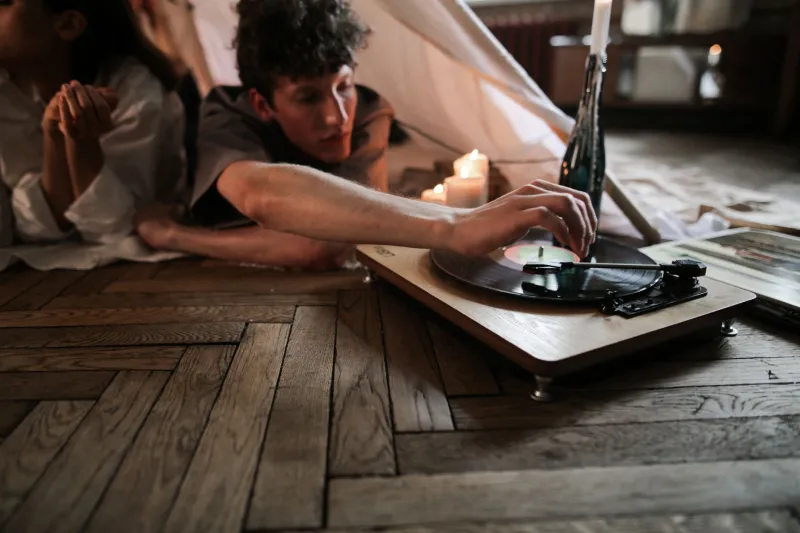
There's an important distinction to make here, and longtime heads will feel it immediately. Replaying is passive. You throw something on while you're making dinner or driving through Ohio. Returning is something else entirely — it's intentional, almost ritualistic. You sit down with it. You bring yourself to it.
Mark T., a 58-year-old high school history teacher from Asheville, North Carolina, has been returning to the Cornell '77 show for going on three decades. "I was 22 the first time I really heard it," he says. "I thought I understood it. Then I turned 30 and I heard something completely different in 'Scarlet Begonias.' Then my dad died and I heard it again, and I couldn't believe it was the same recording."
That's the thing about a great Dead show — it doesn't sit still. You change, and so the music changes, because the music was always partly made of you.
The Show as Mirror
Psychologists who study music and memory will tell you that emotionally significant recordings act as what they call "autobiographical anchors" — fixed points that the mind returns to in order to locate itself across time. Most people have a handful of songs that function this way. Deadheads, characteristically, have entire concerts.
What makes the Dead particularly potent for this kind of deep return is the architecture of their shows. A typical night wasn't a collection of discrete songs so much as a single extended emotional journey — peaks, valleys, tangents, resolutions. When you return to a full show rather than a single track, you're not just triggering a memory. You're re-walking a path. And paths look different depending on where you are in your life when you walk them.
Rachel V., a 44-year-old graphic designer from Portland, Oregon, has been returning to the Red Rocks run from 1978 since she found the tapes in her late father's collection in 2006. "He never talked about going to those shows," she says. "So every time I listen, I'm partly trying to find him in there. And I keep finding different versions of him. Which means I keep finding different versions of myself, too."
What the Repetition Actually Does
Here's what's genuinely fascinating from a neurological standpoint: repetition doesn't flatten the experience of a great Grateful Dead show. It deepens it. Each return adds a layer of personal history on top of the musical event itself, until what you're listening to is no longer just a concert from a specific date and venue — it's a kind of sedimentary record of your own life.
Deadheads figured this out intuitively long before anyone put a scientific framework around it. The trading culture, the obsessive cataloging, the way heads talk about specific shows with the reverence usually reserved for sacred texts — all of it points to a community that understood, collectively, that these recordings weren't artifacts. They were living documents.
"I've changed my mind about songs," says Tom R., a 63-year-old retired electrician from outside Columbus who has returned to the 1972 Europe tour recordings more times than he can count. "I used to skip past 'He's Gone.' Now it's the one I wait for. That's not the recording changing. That's me."
The Five-Song Rule (And Why It's Not Really About Five Songs)
There's an informal idea that circulates in certain corners of the Dead community — the notion that every truly great show has at least five moments that hit different on every listen. Not five songs, necessarily. Five moments. A pause before a jam erupts. A key change that arrives like weather. A crowd response that becomes part of the music itself.
This is why the covenant forms around specific shows rather than specific songs. A single track can be amazing, transcendent even. But a full show with five of those moments? That's something you can spend a lifetime with. That's a place you can keep going back to and keep finding yourself inside.
The Dead, almost uniquely among rock bands, created enough of those places that different fans ended up with completely different shows as their anchor. Cornell '77 is the famous one, the one that gets written about and argued over. But talk to enough Deadheads and you'll find people carrying Veneta '72, or Winterland '74, or some show from a mid-sized venue in 1980 that most people have never heard of — and for each of them, that show is the one. The one that keeps speaking.
The Community Inside the Return
One of the less obvious dimensions of this phenomenon is how social it can be, even when it looks solitary. Deadheads who return obsessively to the same shows often become de facto experts on those recordings — they notice things, catalog discrepancies between different tape generations, develop opinions about which mix captures the room most accurately. And that expertise becomes a form of connection.
Online communities have formed around specific shows. People trade notes about what they hear on their fiftieth listen that they didn't catch on their fifth. The act of returning becomes a conversation across time, across geography, across generations of fans who may have nothing in common except that they both keep coming back to the same ninety minutes of music from a gymnasium in 1973.
That's the covenant in its fullest form. It's not just between a fan and a recording. It's between a fan and everyone else who has ever sat down with that same night and let it do whatever it does to them.
Why It Matters That You Keep Going Back
In a culture that increasingly treats music as content — something to be consumed, shuffled, moved past — the Deadhead practice of deep return feels almost countercultural. It's a refusal to let a piece of music be used up. It's an insistence that the relationship between a listener and a recording can be ongoing, evolving, genuinely alive.
The Dead, in a real sense, built shows that demanded this. The improvisational structure meant there was always more to find. The emotional range meant you'd always arrive at different points in the journey depending on where you were in your own life. The sheer duration meant you had to commit — and commitment, over time, becomes something that looks a lot like love.
Same show. Different soul. Every single time.
That's the point. That was always the point.