When the Room Starts to Breathe: How Deadheads Cracked the Code of a Night's Hidden Shape
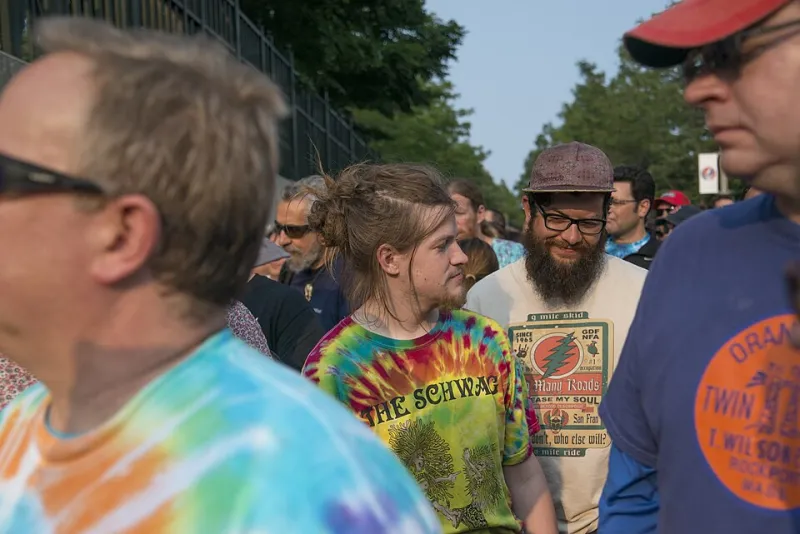
Photo: naleck, CC BY 2.0, via Wikimedia Commons
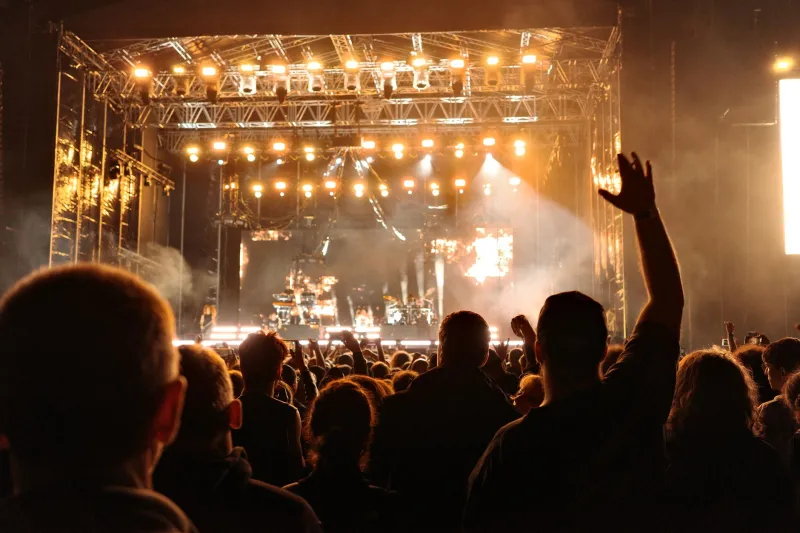
You're standing in the middle of a crowd that smells like patchouli, spilled beer, and something vaguely herbal. The first song is already unwinding. And somewhere around the five-minute mark — not the five minutes of any particular song, but five minutes into the night — the experienced Deadheads around you start doing something subtle. They're listening differently. Heads tilting. Eyes going soft. They're not just hearing music. They're reading it.
This is the moment the room starts to breathe.
The Grammar Nobody Wrote Down
The Grateful Dead never published a rulebook. There was no official document explaining that a "China Cat Sunflower" opener suggested one kind of night while "Bertha" signaled another. No annotated guide existed for what it meant when Jerry reached for a certain melodic phrase early in the first set, or why Bill Kreutzmann's tempo choices in the first twenty minutes could telegraph the emotional register of everything that followed.
And yet, over years of showing up — night after night, city after city, parking lot after parking lot — a generation of fans absorbed this grammar anyway. Oral tradition. Tape trading. The long conversations that stretched from venue to venue across the American highway system. Deadheads built a working literacy around a language the band itself never formally defined.
Call it the hidden architecture. Every show had one. And learning to recognize it, in real time, became one of the defining skills of the devoted fan.
Five Minutes as a Diagnostic Window
There's a reason the five-minute mark keeps coming up in conversations among longtime Deadheads. It's not arbitrary. The first few minutes of any show carry the weight of the unknown — the band is warming up, the sound is settling, the crowd is still finding its footing. But right around that five-minute threshold, something clarifies.
If the band opened loose and exploratory, and they're still loose at minute five, that's information. If they opened tight and locked in, and that tightness is holding, that's different information. The energy of those first minutes isn't random noise — it's the opening statement of an argument the band is about to make across two full sets.
Veteran fans started treating that window the way a seasoned poker player treats the first few hands of a night. Not definitive. Not conclusive. But diagnostic. You're not predicting the future, exactly. You're calibrating your expectations based on the earliest available evidence.
And the remarkable thing? They got pretty good at it.
Song Choices as Sentences
Here's where it gets genuinely fascinating. The Grateful Dead's repertoire was enormous — hundreds of songs spanning folk, blues, psychedelia, country, jazz, and whatever genre defies easy labeling. On any given night, the band could theoretically open with almost anything. But in practice, certain choices carried weight that extended beyond the song itself.
A "Truckin'" opener in the early '70s sent a particular signal. "Help on the Way" into "Slipknot!" into "Franklin's Tower" was a complete structural statement — a three-part suite that told the crowd: we are organized tonight, we are intentional, we are building. Conversely, an unexpected deep cut in the first slot — something rare, something dusted off from the vault — often signaled a night where the band was in an exploratory mood, willing to take risks, less interested in crowd-pleasing and more interested in following wherever the music led.
Deadheads learned to parse these choices the way a literature student learns to read the opening paragraph of a novel. The first line tells you something about the author's intentions. It doesn't tell you everything. But it tells you something.
The Thematic Arc Across an Entire Evening
What separates casual appreciation from genuine Deadhead fluency is the ability to hold the whole night in mind simultaneously — to hear a song choice in the middle of the second set and understand it in relation to everything that came before it.
This is harder than it sounds. It requires memory, pattern recognition, and a willingness to sit with ambiguity. A song that seems like a non-sequitur in isolation might reveal itself as a deliberate pivot when you remember what preceded it. A jam that felt like it was going nowhere might have been, in retrospect, the necessary clearing of emotional space before the song that followed.
Long-time fans developed a kind of structural memory for this — an ability to hold the first set in the back of their minds while experiencing the second, recognizing callbacks and thematic rhymes that the band may or may not have intended consciously. Whether Jerry and Bobby were building these arcs deliberately or whether the architecture emerged organically from collective improvisation almost doesn't matter. The structure was there. The fans found it.
Reading the Room Reading the Band
Here's the twist that makes this whole phenomenon genuinely strange and wonderful: the band was reading the audience, too.
Deadheads who've spent time studying the recordings — particularly the taper sections, where crowd ambience is captured with unusual clarity — often note how the energy in the room seems to inform the band's choices. A crowd that's particularly alive during a first-set jam might find that jam stretching longer than expected. A room that goes quiet and reverent during a ballad might receive a second ballad in short succession, the band leaning into what the audience is offering.
This feedback loop is part of what made the hidden architecture so hard to pin down definitively. It wasn't just the band imposing a structure on the night. It was a negotiation — a real-time conversation between performers and audience, conducted entirely without words, mediated entirely through music.
The five-minute window wasn't just when the Deadheads started reading the band. It was when the band started reading them back.
What the Archive Reveals
Decades of recordings have given us something extraordinary: the ability to go back and test these intuitions against the historical record. When a veteran Deadhead says that a particular 1977 show felt like it was building toward something from the first song, we can now listen to that show in its entirety and ask whether the feeling was justified.
More often than not, it was. The hidden architecture holds up. The song choices that felt meaningful in the moment turn out to be meaningful in retrospect. The thematic arcs that seemed to be emerging actually emerged. The diagnostic window of those first five minutes — that moment when the room starts to breathe — proves, again and again, to have been telling the truth.
That's not magic. That's literacy. A whole community of people taught themselves to read something that nobody had written down, and the archive is the proof that they got it right.
Some nights, the Dead were just playing songs. But on the nights that mattered — the ones that end up on lists, that get passed around on tape, that still get discussed in forums forty years later — they were building something. And somewhere in that first five minutes, the people who knew how to listen could feel the foundation going in.